Divine Principle First Design
The Seven Deadly Sins of Tech
There's an image that circulates online mapping the seven deadly sins to the platforms that weaponized them:
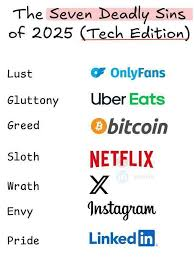
- Lust: OnlyFans
- Gluttony: Uber Eats
- Greed: Bitcoin
- Sloth: Netflix
- Wrath: X (Twitter)
- Envy: Instagram
- Pride: LinkedIn
This is funny. It is also completely accurate. And it reveals something most builders never think about: every successful platform is the manifestation of a spiritual principle into technology. The question is which principle.
Instagram did not set out to build an envy machine. The founders probably wanted to help people share photos with friends. But the design choices they made (public follower counts, likes as social currency, algorithmic feeds optimized for engagement) created a system that rewards comparison, vanity, and performative living. The principle the system embodies is envy, whether or not anyone intended it.
The principle was never stated. It was never designed for. It emerged from optimizing for engagement metrics, because engagement metrics are spiritually agnostic. They measure attention without asking what that attention is doing to the soul. And when you build a system without asking what it does to the soul, Satan will happily fill in the blank.
This is sinfrastructure by design.
The Problem With Specs
Most builders start with features. "We need a feed. We need profiles. We need a messaging system. We need an invite model." They work backward from what other platforms have, remix the UX patterns, add their twist, and ship.
Some builders start with goals. "We want 10,000 users in 90 days. We want 40% weekly retention. We want $50 LTV." They work backward from metrics and build whatever moves the numbers.
Both approaches produce the same thing: technology that has no soul. Technology that may have started with good intentions but drifts toward whatever pattern generates the most engagement, the most retention, the most revenue. And those patterns, left unchecked, always converge on the deadly sins, because the deadly sins are the most reliable drivers of compulsive human behavior.
KPIs kill the spirit of an initiative. The moment you make a metric the thing you optimize for, you incentivize gaming over genuine service. Nonprofits know this intimately: every grant cycle forces them to warp their mission to fit a funder's criteria, graduating more people from a program even if the graduation means nothing, reporting higher numbers even if the numbers mask declining quality. The KPI becomes the master. The mission becomes the servant.
"No man can serve two masters: for either he will hate the one, and love the other; or else he will hold to the one, and despise the other. Ye cannot serve God and mammon." (Matthew 6:24)
This applies to product design as directly as it applies to personal finance. You cannot serve a divine principle and a vanity metric simultaneously. The metric will win because the metric is measurable and the principle is not. And when the metric wins, the spirit of the project dies.
Principles Are Not Implementations
There is a critical distinction that most builders collapse, and it kills projects before they start.
"I want to maximally protect the privacy of my members" is a divine principle. It is a statement about what you value and what spirit you want the system to embody.
"I want to use zero-knowledge proofs" is an implementation. It is one possible way to realize that principle. Maybe the right way. Maybe not. Maybe today. Maybe in two years when the tooling matures.
When you lead with the implementation, you lock yourself into a technical path before you understand the spiritual requirement. You start arguing about ZK vs. encryption vs. on-device processing when the real question is: do the people in this system feel protected? The implementation is the how. The principle is the what. The what must come first and the how must remain flexible, because the right implementation changes as technology evolves, but the divine principle never does.
This is where specs go wrong. A spec full of feature requirements ("we need end-to-end encryption, we need invite trees, we need reputation scores") looks rigorous. But it is a house built from the roof down. The features are disconnected from the spiritual purpose they are meant to serve, so they drift, get gamed, or solve the wrong problem entirely.
A spec built from divine principles looks different. It says: "This system exists to protect the dignity and privacy of every member. Every design choice must serve that principle. Here are some ways that might work." The principle constrains the design space. The implementation stays open to whatever best serves the principle today.
God's commandments work the same way. "Love thy neighbor as thyself" is the principle. How you love your neighbor in first-century Jerusalem looks different from how you love your neighbor in 2026 Austin. The principle is eternal. The application is contextual. Divine Principle First Design follows the same pattern.
Start With Divine Principles
What if you started from the other direction entirely?
Instead of "what features do we build?" or "what KPIs do we hit?", start with: what divine principle does this system embody?
A divine principle is a fruit of the Spirit (Galatians 5:22-23) made structural. It is love, joy, peace, patience, kindness, goodness, faithfulness, gentleness, or self-control encoded into how a system works, who it rewards, and what behavior it makes frictionless.
Examples:
- A system designed around faithfulness would reward people for depth of relationship over breadth of connection. It would make it easy to invest in a few people deeply and hard to accumulate shallow followers.
- A system designed around kindness would reward people for genuinely helping others and make that help visible and attributable, without turning it into a performance.
- A system designed around patience would resist the temptation to optimize for instant engagement and instead reward long-term contribution that compounds.
- A system designed around self-control would limit how much content you can consume in a session, by design, because the builder cares more about your soul than your screen time.
None of these sound like a modern social network. That is the point. Modern social networks are designed from deadly sins. What I am describing is technology designed from divine principles.
The Soul of a Project
Every project that comes from God has a spirit. You can feel it when it is alive and you can feel when it is being strangled.
The spirit of a project is strangled when:
- A funder's KPI replaces the founder's calling as the thing being optimized for
- An investor's growth timeline overrides the natural pace of trust-building
- A metric that was meant to be a health check becomes the goal itself
- The person at the center of the project starts serving the system instead of the system serving the people
The human unicorn at the center of a divinely inspired project cannot be managed by metrics optimized for Wall Street. That person must be the bearer of divine principles. Their gut, calibrated by the Holy Spirit, is the measurement instrument. Do the people in this community feel valued? Is the quality of contribution rising or falling? Is this system making people more generous or more competitive? These are questions only a Spirit-led leader can answer honestly. No dashboard will tell you.
This does not mean you ignore data. It means the data serves the principle. The principle never serves the data.
The Inversion
Here is the design challenge worth spending your life on:
Instagram made envy go viral. What system makes generosity go viral?
Twitter made wrath go viral. What system makes peace go viral?
LinkedIn made pride go viral. What system makes faithfulness go viral?
OnlyFans made lust go viral. What system makes self-control go viral?
The deadly sins went viral because the platforms made them frictionless. Envy is one tap away. Wrath is one reply away. Lust is one swipe away. The design is so smooth that people fall into sin without deciding to.
Divine Principle First Design asks: can you make the fruits of the Spirit equally frictionless? Can you build a system where being kind is easier than being cruel? Where investing deeply in a few people is easier than accumulating shallow followers? Where contributing real value to a community is easier than performing for attention?
If the deadly sins can be made frictionless through design, so can the fruits of the Spirit. The problem is that nobody with the talent to build this has been asking the right question. They have been asking "how do we grow?" instead of "what spirit does this system embody?"
Designing From Principles in Practice
Divine Principle First Design is a posture, not a methodology. You do not get a checklist. You get a discipline.
Step 1: Name the divine principles your system exists to embody. Write them down. Three to five, maximum. These are your design boundaries. Every structural decision must serve at least one of them and violate none of them.
Step 2: For each principle, ask: what behavior would a person exhibit if this principle were alive in them? That behavior is what your system should make frictionless.
Step 3: For each behavior, ask: what is the opposite behavior that the deadly sins would produce? That behavior is what your system should make difficult or impossible by design.
Step 4: Protect the spirit. When growth pressure, investor pressure, or metric pressure asks you to compromise a design boundary, say no. The spirit of the project is more important than the scale of the project. A small system that embodies divine principles is infinitely more valuable than a large system that embodies deadly sins.
Step 5: Let the Holy Spirit be your product manager. The questions that matter ("does this community feel alive?" "are people becoming more generous or more competitive?") are spiritual questions. No A/B test will answer them. Pray. Listen. Observe. Trust your Spirit-calibrated discernment over your dashboard.
"But the fruit of the Spirit is love, joy, peace, longsuffering, gentleness, goodness, faith, meekness, temperance: against such there is no law." (Galatians 5:22-23)
Against such there is no law. There is also no KPI. The fruits of the Spirit are their own metric. When they are present, you know. When they are absent, you know. Trust that knowing.
Why This Matters Now
We are in the Genesis Layer. The cost of building technology has collapsed to near zero. Anyone can build anything. The bottleneck is no longer execution. The bottleneck is discernment: knowing what to build and what spirit it should carry.
This is exactly where the obedient have the advantage. The Holy Spirit gives 100x choices about what to build. Divine Principle First Design gives the framework for how to build it without killing the spirit in the process.
The world has had enough technology built from deadly sins. What it needs now is technology built from the fruits of the Spirit: systems that make people more generous, more faithful, more kind, more patient, more self-controlled. Systems where the soul of the project is protected by design, where the leader answers to God before they answer to investors, and where growth is measured by spiritual fruit instead of vanity metrics.
The platforms that embodied deadly sins captured billions of souls. Imagine what platforms embodying divine principles could liberate.
Related: Recognize and Resist Sinfrastructure | The Founder as Sub-Creator | The Genesis Layer | The 100x Choice | Art as Sybil Resistance